Friday, November 10, 2023

Homo Sapiens: Innovations in Money

What made humans create money? 

Homo sapiens are adept at inventing imaginary concepts like money, superbeings, and belief systems, fostering unparalleled collaboration. Monkeys can collaborate only in fingerful numbers, but humans, with their imaginary creations, can collaborate in planetful numbers.

Humans invented belief systems, allowing large groups to share a common set of morals and beliefs, enhancing great human collaboration.

Money, his next imaginary system, transcends various belief systems, cultures, and religions, connecting all humans. Sapiens turned paper into an 'I owe you' dollar note. On a dollar bill, you'll find 'Federal Reserve Note' and 'This note is legal tender for all debts, public and private'. For monkeys, a coconut for a banana makes sense; paper does not. But humans use special paper as money to sell a banana and buy pepper with the same paper in a shop. As long as everyone agrees and honors the paper, it makes sense as money in human imagination. Before paper, there were barter system, commodity money, and metal money.

Bitcoin is a modern invention akin to 'unbreakable money,' a transition from physical to digital currency, akin to shifting from ritual to virtual/spiritual reality. More powerful than any government note, Bitcoin is virtual, with no physical form like the concept of Brahman in Hindu philosophy - neither form nor formless. Just as Brahman eludes definition, Bitcoin defies the conventional understanding of what currency should be – an ethereal presence, both everywhere and nowhere at once.

Unlike centralized government-issued paper currency, Bitcoin is decentralized, beyond any single government's control. If governments try to challenge it, draws strength, becoming more robust against these attacks (like the character Vali in the Ramayana, who gains half of his opponent strength). In the face of opposition, Bitcoin, too, adapts, like Mahishi taking many copies of herself to storm the Svargaloka/celestial world/heaven in Ayyappan mythological story.

Though invisible, Bitcoin's transactions are invincible, due to 'proof of work.'

Bitcoin encompasses thousands of years of monetary history, blockchain technology, cryptography, decentralization, Proof of Work (PoW), digital scarcity, trust in technology, investment psychology, supply and demand, inflation, monetary policy, open-source development, communication network, network consensus, game theory, philosophy, energy, software, legal frameworks, and financial innovation.

Governments might be compelled to embrace or replicate Bitcoin's methodology. It's nearly impossible to counterfeit, and its high divisibility allows for micro-transactions. It's accessible to the unbanked population, offering transparency and the ability for public auditing, reducing fraud and corruption. It also supports smart contracts within its ecosystem. You can send the money to remote parts in a remote continent who doesn't even have bank account. It is too difficult to accomplish with a fiat currency.

Bitcoin, limited to 21 million coins, creates 'digital gold,' an evolution of the gold standard used by civilizations like the Varna, Sumerians, Minoans, Greeks, Romans, and Egyptians, who valued gold for its rarity and used it extensively.

Bitcoin transactions are pseudonymous, conducted using public addresses (a string of alphanumeric characters) rather than personal information like names or physical addresses. Every Bitcoin transaction is recorded on a public ledger and the transactions are linked to Bitcoin addresses, not directly to personal identities. Bitcoin transactions are traceable and permanently recorded on the blockchain without a identify disclosure. The system relies on cryptographic principles to secure transactions. With additional tools, users can further obfuscate the link between Bitcoin transactions and their real-world identities.

Bitcoin's immutability ensures the integrity of every transaction, offering zero-cost transactions even for large amounts, like a $2 billion transfer in August 2023.

El Salvador's decision to adopt Bitcoin aims to assist its 70% unbanked population and manage remittances, which comprise over 20% of its GDP, a path also followed by the Central African Republic.

Every individual on our planet has the potential to explore the wealth trillions of stars and planets in the universe. Learn how to swim and sail safely in the ocean of wealth/money. You cannot drink all the ocean of wealth but enjoy your shared journey in the ocean of wealth. 


Tuesday, October 17, 2023

Organic Homo Sapiens and Inorganic AI/Robo Sapiens Machines

Homo Sapiens machine is an organic/biologic algorithm. AI/Robo Sapiens machine is an inorganic algorithm.


Homo Sapiens (Organic/biologic Algorithm):

Based on: Biological processes, evolutionary history, and biochemical reactions.

Processing: Brain and nervous system.

Learning: Through experience, sensory input, and genetic evolution.

Limitations: Bound by biological needs, lifespan, physical capabilities.

AI/Robo Sapiens (Inorganic Algorithm):

Based on: Coded instructions, computational processes.

Processing: Computers, servers, and digital networks.

Learning: Through data analysis, pattern recognition, and algorithm optimization.

Limitations: Bound by programming, available data, computational resources.

This perspective offers a fresh lens through which we can understand the dynamics of both organic life and artificial constructs. It also raises philosophical and ethical questions about consciousness, free will, and the nature of intelligence. 

Saturday, October 7, 2023

Great sayings... Aham Brahmasmi (Upanishad) and ஒன்றே குலம் ஒருவனே தேவன் (திருமந்திரம் - Thirumanthiram by Thirumoolar 6th Century)

A popular Tamil saying "One race, one God" - ஒன்றே குலம் ஒருவனே தேவன்  (Tamil)

Recent great saying "ஒன்றே குலம் ஒருவனே தேவன் - One race, one God" is attributed to C.N. Annadurai, a prominent political leader and former Chief Minister of Tamil Nadu, May 30th 1967. 

A similar great saying is "Aham Brahmasmi" (Sanskrit: अहम् ब्रह्मास्मि )  - Brihadaranyaka Upanishad 1.4.10 of the Shukla Yajurveda

"I am Brahman" or "I am the Ultimate Reality."

Aham: This word means "I" or "self." It refers to the individual self or ego.

Brahma: This term refers to "Brahman," which is the ultimate, unchanging, and absolute reality in Hindu philosophy. Brahman is often described as the supreme, formless, and infinite cosmic consciousness or divine principle.

Asmi: This word means "am" or "is."

Individual self, or "I," is not separate from the ultimate reality, Brahman. It signifies the realization of one's true nature as being inherently connected to the divine and that the individual self is an expression of the same universal consciousness that is Brahman. This realization is a central concept in Advaita Vedanta, a non-dualistic school of Hindu philosophy, and it underscores the unity and oneness of all existence.

Similar great sayings or  Mahavakyas

Ekam evadvitiyam brahma (Chāndogya Upanishad 6.2.1) - Brahman is one, without a second.

So 'ham (Isha Upanishad 1.16) - I am that.

Sarvam khalv idam brahma (Chāndogya Upanishad 3.14.1) - All of this is Brahman.

Tat Tvam Asi (Chandogya Upanishad 6.8.7) - You are that.

Etad vai tat (Katha Upanishad) - This, verily, is That

Prajñānam Brahma (Aitareya Upanishad 3.3 of the Rigveda) - Consciousness is Brahman

Ayam Atma Brahma (Sanskrit: अयम् आत्मा ब्रह्म), Mundaka Upanishad 1-2)  - Atma is Brahman


(Tamil) 

“ஒன்றே குலமும் ஒருவனே தேவனும்

நன்றே நினைமின் நமன்இல்லை நாணாமே 

சென்றே புகும்கதி இல்லை நும்சித்தத்து

நின்றே நிலைபெற நீர்நினைந்து உய்மினே”

(Paadal 2104, Thirumandram by Thirumoolar)

https://www.dinamani.com/weekly-supplements/vellimani/2020/sep/18/mantra-is-worshiped--thirumanthiram-is-worshiped--one-clan-and-one-god---17-3467784.html

Saturday, September 30, 2023

Life eats life design

A life design, life eat life. Either you are a hunter or hunted.

A life paradox, while you are hunting for food, you are being hunted for food.

Is this design the intention of the designer? 

Is it intention of the designer for the designed to design on their own for a better design?

Or no designer at all and you are on own. Is it a game of chance?

Perhaps we need many thinkers like the ancient times.

https://fb.watch/noorzScUIx/?mibextid=qC1gEa

Rigveda (Mandala 10: Hymn 129)

Who really knows?

Who will here proclaim it?

Whence was it produced?

Whence is this creation?

The gods came afterwards, with the creation of this universe.

Who then knows whence it has arisen?

Whence this creation has arisen

- perhaps it formed itself, or perhaps it did not -

the One who looks down on it,

in the highest heaven, only He knows

or perhaps He does not know.

Monday, August 28, 2023

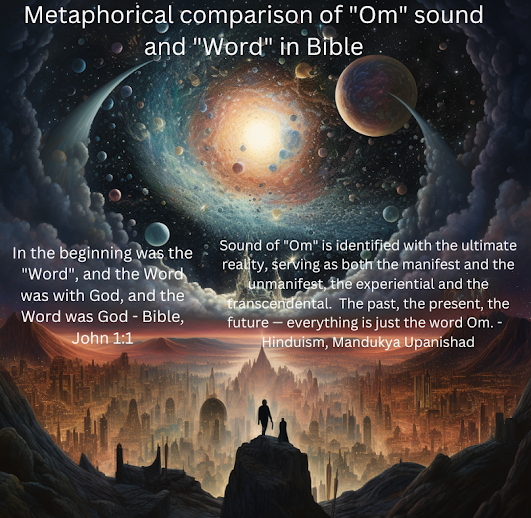
Metaphorical comparison of "Om" sound and "Word" in Bible


In the beginning was the "Word", and the Word was with God, and the Word was God - Bible, John 1:1

Sound of "Om" is identified with the ultimate reality, serving as both the manifest and the unmanifest, the experiential and the transcendental.  The past, the present, the future — everything is just the word Om. -  Hinduism, Mandukya Upanishad


Sunday, August 20, 2023

Metaphorical comparison of ancient cyclical times and modern cyclic universe hypothesis.

Kaliyuga: In ancient thought in Hinduism, time is seen as cyclical, comprising of four ages or Yugas: Satya (or Krita), Treta, Dvapara, and Kali. It is believed the cycle will restart with the Satya Yuga. Total time is 4,320,000 years (= Satya Yuga 1,728,000 years + Treta Yuga 1,296,000 + Dvapara Yuga 864,000 + Kali Yuga 432,000)

Oscillating Universe (Cyclic Universe): One of the hypotheses in cosmology states that universe undergoes an infinite series of oscillations, where it expands, contracts, and then begins again. Each cycle can be seen as a Big Bang followed by a 'Big Crunch', only to be reborn again in a new Big Bang. The idea addresses questions about the ultimate fate of our universe and its possible rebirth.


Saturday, August 19, 2023

The ancient and modern dreams of finding infinite limits

Infinite Dreams in Mythology

In a competition between Lord Vishnu and Lord Brahma to the infinite top and bottom ends of Shiva, as in a form of pillar light, Brahma lied, and Vishnu humbled to find the limits of infinite. 

Infinite in Science

In science, the observable universe diameter is about 93 billion light-years. Anything beyond that distance is currently beyond our observational capabilities but its infinite existence still unknown.

Exploration of infinite limits will go on.


Monday, August 14, 2023

Ancient observable flat earth and modern observable flat universe

Observable Earth was flat in the ancient times. 

Lord Vishnu covered entire earth with one feet and sky with other feet in Vaman Avatar (in a dwarf human form)

https://www.forbes.com/sites/startswithabang/2017/11/24/five-impossible-facts-that-would-have-to-be-true-if-the-earth-were-flat 

Observable universe is flat in modern times. 

https://www.livescience.com/what-is-shape-of-universe 

What are your dreams which hold the future?


Additional conversation between two friends on this topic.
Person 1 : Ayya. Ippo enna solla varreengo? (What are you trying to say?)
Person 2: Universe may not be flat. Perhaps we are on the universe bubble though appear to be flat and observable distance is 93 billion light-years away. Perhaps we may have multiple universe bubbles. We do not know what we do not know😀

Person 1: Is it true that the observable distance is only such that the light reaches. If it is beyond 93 billion LY, the light never reaches us. Yeah, we don’t know what we don’t know. 
The small little brain of a human trying to fathom the Universe!!  
Person 2: Yes, that's correct. The observable universe refers to the region of space from which light has had enough time to reach us since the beginning of the universe. Beyond this distance, light hasn't had enough time to travel to us yet, so we can't observe objects or events that are farther away. This is why the observable universe is often described as having a diameter of about 93 billion light-years – it's the maximum distance from which light has had time to reach us. Anything beyond that distance is currently beyond our observational capabilities.

Person 1: It was Interesting to read that the NASA satellite sent the last picture before shutting down the camera to conserve energy was at 15 billion miles from Earth. The time it took to reach Earth was 21 hours (moves at the speed of light). 

Pluto is not even a light-day away!!

With that logic it is almost unimaginable what 93 billion light years distance would be!!!
🤔🙏


Saturday, June 24, 2023

Comparison of Thai and Tamil language months and its corresponding stars, zodiac and/or constellations

.

The Tamil months are related to the full moon and stars in a way that the name of each month is based on the star that is ascendant on the full moon day of that month.


Saturday, June 10, 2023

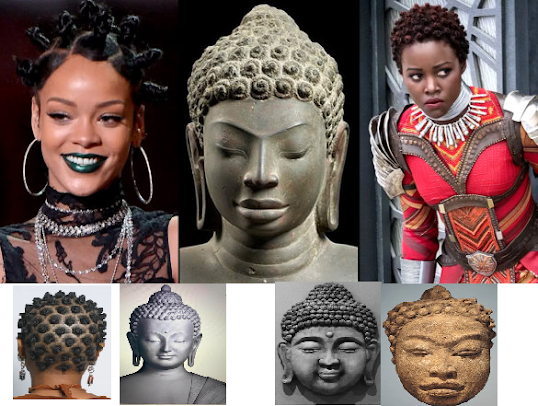
Buddha Bantu Knot and African Bantu Knot & African Murungu and Indian Murugan: More than just a hairstyle, they indicate ancient cultural connection

Murungu & Murugan connection between India and Africa

Murungu deity is the mountain deity of Africa. In East Africa, about 25 tribes including Kikuyu and Meru, Murungu is acknowledged as a high deity. A similar mountain god Murugan is worshipped in southern India,also known as Kartikeya. Most of his six temples in mountains (known as Arupadaiveedu in tamil). 

Ancient India, especially the southern Dravidian regions, and Ethiopia had maritime trade connections. There are physical characteristics of Dravidian and East African populations.

Bantu Knot connection between India and Africa

Buddha Bantu knots very common in Africa. Buddha statue has been recently discovered in Egypt, providing new insights into the cultural connections between ancient Egypt and India. The Bantu knots, as we know them today, have their roots in the Bantu-speaking tribes of Southern Africa. The term "Bantu" is a general term used to describe the 300 to 600 ethnic groups in Africa who speak Bantu languages. The migration of Bantu-speaking people across Africa, which occurred around 1000 BC to 1700 AD, likely spread the hairstyle throughout the continent. Bantu knots were not just a style; they held social significance.